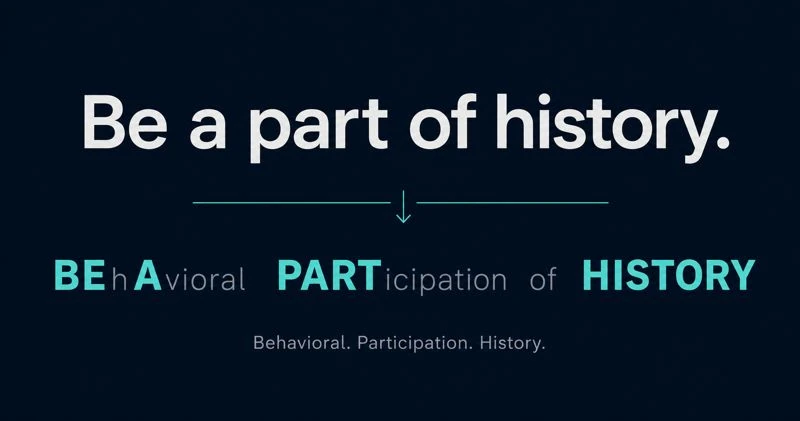
"Be a part of history."
You've heard it a thousand times. Recruiters use it. Politicians use it. Marketers use it. It's the phrase you're invited into when someone wants you to feel that the moment is larger than yourself.
Read it again. With different emphasis.
The first three letters of "Be a" -- B, E, A -- also appear, in order, inside the word "Behavioral." The word "part" is the start of "Participation." The word "history" is itself.
That's not a coincidence. It's a recognition. The architecture was always inside the phrase. We just hadn't built the substrate to make it queryable.
Behavioral
Why "behavioral" specifically?
Not "actions." Not "transactions." Not "events." Not "data." Each of those names a smaller, narrower thing. Actions are discrete. Transactions are commercial. Events are momentary. Data is everything and therefore nothing.
Behavioral implies a pattern that emerges from what an entity does over time, in context, against the conditions that prevailed when it acted. A single transaction doesn't reveal behavior. A thousand transactions across a thousand days reveals behavior -- and the behavior reveals something about the entity that no single transaction could.
Behavioral excludes static facts. The fact that an entity exists, that it has credentials, that it has roles assigned, that it has paid an invoice -- these are not behavior. They are inputs. Behavior is what the entity actually does with its credentials, roles, and access, sustained over time.
This is the layer that's missing under every authorization system in production today. Authorization checks credentials and policy. It doesn't check what the credentialed entity has done with its credentials before. The behavioral layer is what makes the authorization decision context-aware.
Participation
Why "participation" specifically?
Not "presence." Not "membership." Not "identity." Not "activity." Each of those names a related but different concept.
Presence is just being in a system. You can be present and do nothing. You can be present and do nothing meaningful. Presence carries no information about what you've contributed.
Membership is a status. You're either a member or you're not. Membership is binary; it doesn't accumulate; it doesn't compound.
Identity is who you claim to be. Identity is structurally upstream of behavior -- it tells the system who's about to act, not what they've done.
Activity is the broadest possible noun for "things happening." Activity logs are what most systems already produce. They're useful for forensics. They are not what you query at the moment of decision.
Participation implies acting within a context that records, with the result that the participation accumulates and counts. Every event the entity contributes adds to a recorded history that the consuming system can query at the moment of decision. The system isn't told what the participation means -- it's given the verifiable record of what was done, and decides for itself. Participation has a temporal arc.
History
Why "history" specifically?
Not "log." Not "record." Not "trail." Not "data." Each of those names a storage construct, not a temporal one.
A log is a sequence of events. You query it. You search it. You aggregate it. The log is a passive record waiting to be asked.
A record is a unit. A row in a table. A document in a store. A record is one fact captured at one moment.
A trail is what you leave behind as you move through a system. A trail is for forensic reconstruction after something has already happened.
History is the integration of all the records, all the events, all the trails into a continuity that can be evaluated as a pattern. History tells you not just what happened, but what's been happening -- what continues, what stopped, what shifted. History is the temporal dimension of behavior.
History is what authorization systems lack at the point of decision. They have logs, records, and trails of past activity. They don't have history as a queryable input. They evaluate the current request against a static policy, not against the entity's history of doing this thing under these conditions.
Three words. One substrate.
If you have behavior without participation, you have surveillance -- you're observing the entity from outside, inferring what it might be doing, modeling its intent. That isn't this.
If you have participation without behavior, you have membership rolls -- you're recording who's in a club, not what they've done in it. That isn't this either.
If you have behavior and participation but not history, you have a transaction stream -- events flying past you in real time with no temporal integration. Still isn't this.
What's being built is the substrate where all three are present and inseparable: behavior that's recorded as participation in a context that integrates over time into history. Cross-organizational where entities span boundaries. Intra-organizational where they don't. Deterministic in computation. Queryable at the moment of decision.
The substrate doesn't make decisions. It records what entities have done. The authorization, governance, and compliance systems above it consume the recording and decide what to do with the evidence.
The phrase was always there because the architecture was always there. We just hadn't built the substrate to make it queryable.
Now it is.
Be a part of history.