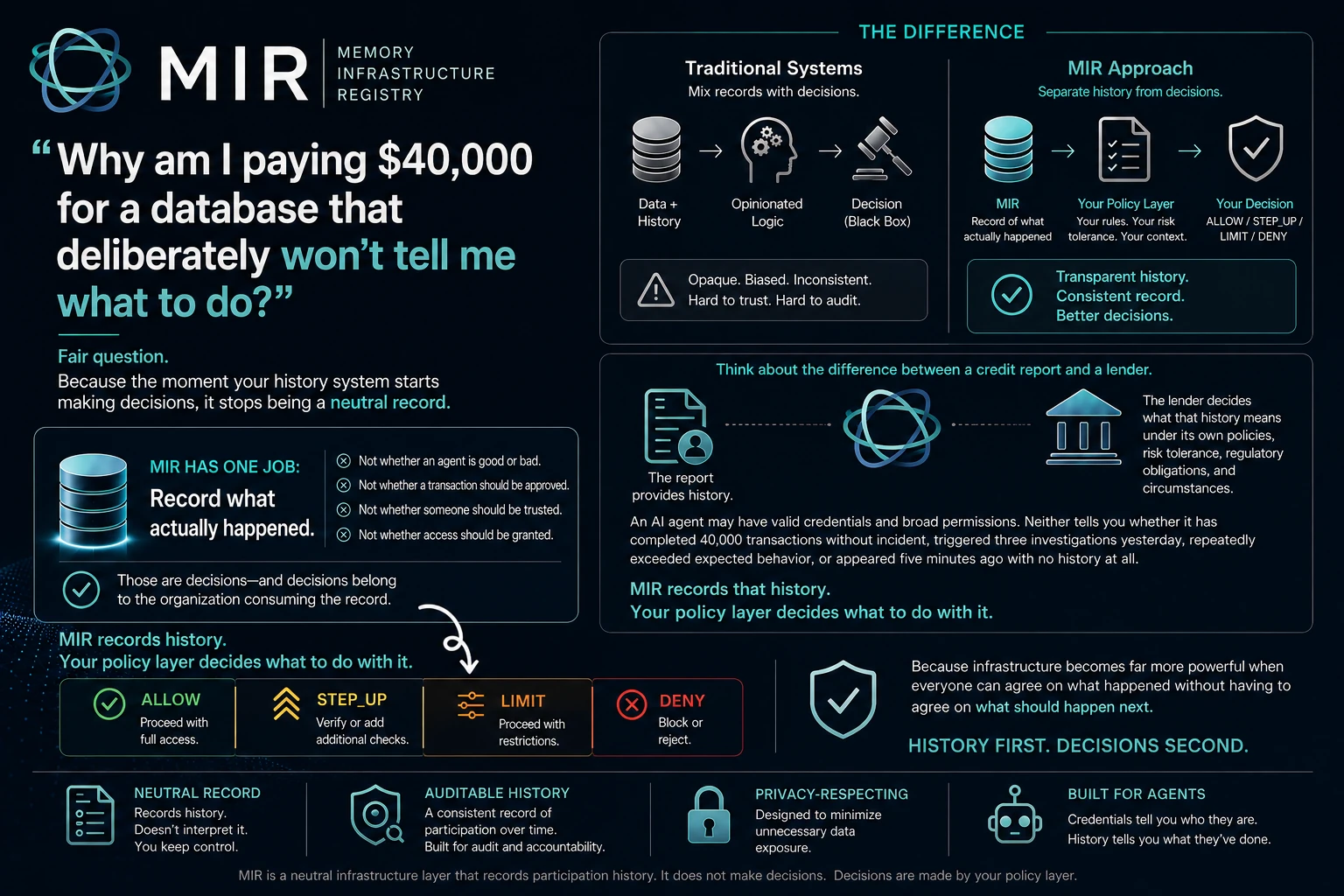
"Why am I paying $40,000 for a database that deliberately won't tell me what to do?"
Fair question. And the answer is the entire point of MIR.
The moment your history system starts making decisions, it stops being a neutral record. So MIR doesn't make them.
One Job: Record What Actually Happened
MIR has exactly one job — to record what actually happened.
Not whether an agent is good or bad.
Not whether a transaction should be approved.
Not whether someone should be trusted.
Not whether access should be granted.
Those are decisions, and decisions belong to the organization consuming the record.
The Credit Report and the Lender
Think about the difference between a credit report and a lender.
The report provides history. The lender decides what that history means — under its own policies, its own risk tolerance, its own regulatory obligations and circumstances. The report never approves the loan. It informs the party who does.
MIR applies that same separation to participation history.
Credentials Don't Tell You What Happened
An AI agent may have valid credentials and broad permissions. Neither tells you what you actually need to know:
- Whether it has completed 40,000 transactions without incident.
- Whether it triggered three investigations yesterday.
- Whether it has repeatedly exceeded its expected behavior.
- Whether it appeared five minutes ago with no history at all.
MIR records that history. Your policy layer decides what to do with it:
MIR doesn't make that call. Deliberately — because infrastructure becomes far more powerful when everyone can agree on what happened without having to agree on what should happen next.
So Why Pay for a Record That Won't Decide?
Because you're not paying for the record. You're paying for the moment you need it.
The Incident
An agent goes wrong — compromised, misused, or just broken. The first question in the room is always the same: what did it actually do?
Without the record, you're guessing. You can't scope the damage, you can't prove what happened, and you can't be sure it won't happen again. With the record, you have the answer in seconds.
The Audit
A regulator — or your own board — asks you to produce the trail: every action, every agent, over time. When supervision and recordkeeping obligations attach to what an agent did, the record isn't paperwork. It's the difference between "here it is" and a finding.
One avoided finding pays for MIR many times over.
The Everyday Decision
Every ALLOW and DENY your policy makes without history is a guess. Guess too loose, and the losses land on your books. Guess too tight, and you're blocking good business and paying in friction.
The record is what turns a guess into a calibrated call — thousands of times a day.
That's the $40,000
Not a database. The one thing that lets you answer "what did it do?" with something other than "we're not sure." Insurance you're glad you carry the day something breaks — and quiet leverage every day it doesn't.
Neutrality Is the Source of the Value
Here's what ties it together: the record can do all three of those things because it doesn't decide.
A record that also judged would be a record you'd argue with. A neutral one is the only kind your auditor, your policy engine, and the other side of a dispute can all trust at once.
The neutrality isn't the cost of the value. It's the source of it.
That's not a limitation of MIR. That's the architecture.
History first. Decisions second.