The Missing Layer
Identity tells you who someone is. Policy tells you what they're allowed to do. Neither tells you what they've actually done. That's the gap.
What is participation history? The verifiable record of what an entity has actually done over time -- transactions, sign-ins, approvals, agent actions -- expressed as structured events submitted by the systems that observed them. MIR stores this record and surfaces it as a signal when high-stakes decisions are made.
New to the vocabulary? See the glossary for every term used on this page.
Same credentials. Same permissions. Different risk.
Every entity in your environment passes the same two checks: identity verification and policy authorization. But those checks return identical results for entities with fundamentally different risk profiles.
What is a tier? A discrete trust level (0, 1, 2, or 3) earned by an entity through accumulated clean participation history. Thresholds are event count + history age -- no machine learning, no opaque scoring. Tier 0 is not a negative judgment; it means the entity has not yet accumulated history. New hires and freshly-provisioned agents both start at tier 0. Full thresholds →
| Identity Layer Who they are |
Policy Layer What they can do |
Participation History What they've done |
|
|---|---|---|---|
| New HireHuman | ✓ Valid | ✓ Authorized | ✗ Tier 0 No history |
| 10-Year EmployeeHuman | ✓ Valid | ✓ Authorized | ✓ Tier 3 200+ events, 90+ days |
| New AI AgentService | ✓ Valid key | ✓ Authorized | ✗ Tier 0 No history |
| Established AgentService | ✓ Valid key | ✓ Authorized | ✓ Tier 2 50+ events, 30+ days |
What changes at the point of decision
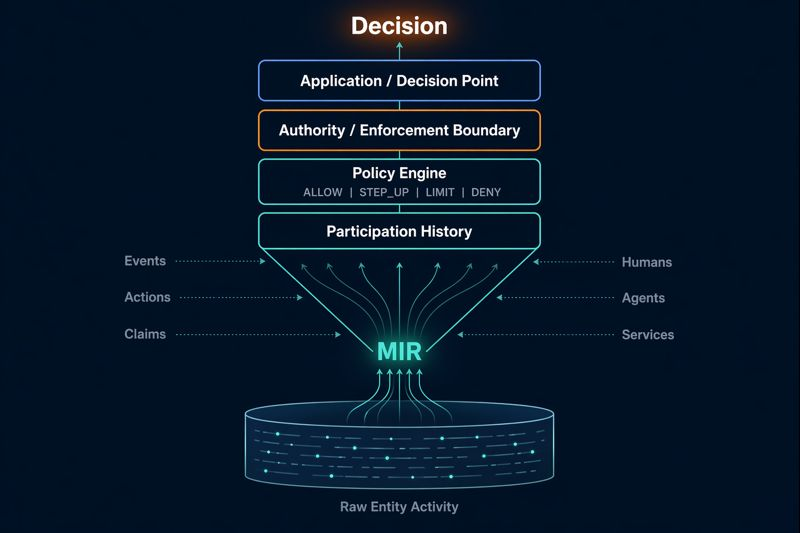
When a high-stakes action is requested, MIR's policy engine checks the entity's accumulated participation history and returns a recommendation: ALLOW, STEP_UP, LIMIT, or DENY.
10-Year Employee
New Hire
Established Agent
New AI Agent
What MIR is
MIR is participation history infrastructure. It records what entities have actually done over time and surfaces that history as a signal at the point of decision. It is not an identity provider, a policy engine, or a scoring system. It is the evidence layer that sits underneath your existing authorization stack.
- Deterministic, not ML. No models, no scores, no opacity. Tier thresholds are event count + history age.
- Recommendations, not decisions. MIR returns ALLOW, STEP_UP, LIMIT, or DENY. Your system decides what to do with it.
- No subject-level PII. External IDs from partner-submitted events are SHA256 hashed. Events carry no free-form metadata. Account-holder login emails and partner admin contacts are stored as operational PII, governed by the DPA.
- Neutral. MIR is infrastructure, not a platform. It serves the entities it tracks, not just the organizations that submit events.
Where MIR sits in the stack
Who uses this
Security Teams
Before granting elevated access, check the requester's behavioral track record. Reduce blind trust in new identities.
AI/Agent Governance
An agent spawned 5 minutes ago and one operating for 90 days are not the same risk. Your system should know the difference.
Compliance
Auditable, timestamped record of what entities actually did. The kind of evidence regulators want to see.
Fraud Prevention
When a transaction triggers a review, see the entity's full behavioral history instantly. Pattern recognition at the point of decision.
See it in action
Try the sandbox with a public API key. No account needed.
Try the Sandbox Talk to Sales